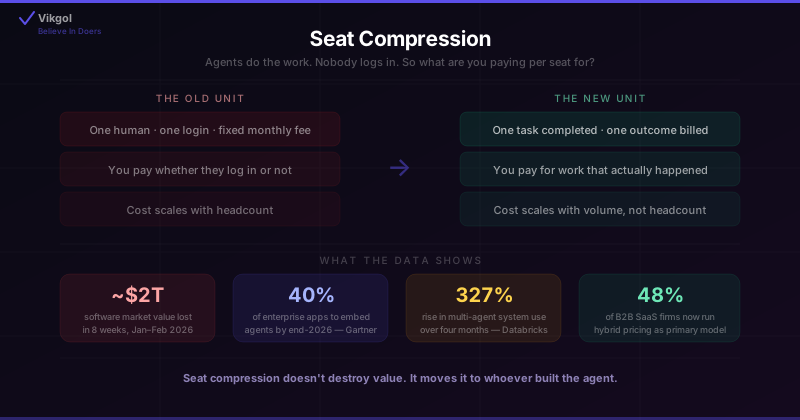
For roughly two decades, enterprise software priced itself identically: a fixed fee per user, per month. You bought a CRM, a project tool, a support desk, an analytics platform — and you paid for every seat whether the person logged in or not.
That model assumed one thing: a human sits behind every login.
AI agents break that assumption. When an agent resolves a support ticket end to end, no seat was consumed. When an agent reconciles invoices overnight, nobody logged in. The work happened. The seat did not.
The market noticed. In January and February 2026, software stocks lost close to two trillion dollars in aggregate market value across roughly eight weeks — the steepest software sell-off since the 2022 rate cycle. Investors were not repricing revenue that had already fallen. They were repricing a unit of measurement that had stopped measuring anything.
📌 Quick Answer: What is seat compression?
Seat compression is what happens when an AI agent completes work that previously required a paid human licence — reducing the number of seats an organisation needs without reducing the value it gets. It does not destroy the economic value of that work. It relocates it, from whoever held the seat to whoever built or operates the agent doing the job.
What the Data Actually Shows
40%
of enterprise applications will embed task-specific AI agents by end of 2026, up from under 5% in 2025
Gartner
327%
increase in multi-agent system usage over a four-month period
Databricks survey, 2026
48%
of B2B SaaS companies now run hybrid pricing as their primary model
B2B SaaS trend research, 2026
Deloitte's 2026 technology predictions describe the same trajectory from the vendor side: as SaaS platforms build agent orchestration into their products, subscription and seat-based licensing is expected to give way to hybrid approaches blending usage and outcome pricing — introducing genuinely new complexity in how software is both implemented and monetised.
You can already see it in individual products. Zendesk runs per-seat pricing for human agents alongside per-resolution pricing for AI agents. ServiceNow has introduced agent SKUs priced per automation rather than per user. Microsoft is testing outcome-based pricing for custom agents built in Copilot Studio.
The Mechanism, Not the Headline
It is tempting to read this as "SaaS is dying." It isn't, and treating it that way leads to bad decisions.
What is actually happening is narrower and more useful to understand: the unit of value is moving from access to outcome. Software that helps a human work faster is priced per human. Software that performs the work itself has to be priced per unit of work — because there is no human to count.
❌ The Seat Era Assumption
Software assists a person
- · One human, one login, one monthly fee
- · Value proportional to headcount
- · You pay for the right to access
- · Unused seats still cost full price
- · Vendor revenue grows when you hire
- · Costs are predictable and flat
✅ The Agent Era Reality
Software performs the work
- · Work happens with no login at all
- · Value proportional to volume of work
- · You pay for results delivered
- · Idle capacity costs nothing
- · Vendor revenue grows when you do more work
- · Costs are variable and need governing
⚠️ The trade-off nobody mentions in the pitch
Variable pricing sounds fairer than paying for empty seats, and often is. But it moves cost from a fixed, forecastable line item to one that scales with volume — and agent workflows make many LLM calls per completed task. Finance teams that budgeted comfortably under per-seat contracts frequently find consumption pricing much harder to forecast. This is why FinOps discipline for AI spend has become a standard requirement rather than an optimisation.
The Three Pricing Models Replacing the Seat
| Model | How it's billed | Who carries the risk | Budget predictability |
|---|
| Consumption | Per task, per API call, per token, or per automation run | The buyer — costs rise directly with volume | Low |
| Outcome-based | Per result achieved — ticket resolved, appointment booked, invoice processed | The vendor — they only get paid when it works | Medium |
| Hybrid | Reduced per-seat base plus usage credits or per-outcome charges on top | Shared | Higher |
| Custom-built agent | One-time build cost plus your own infrastructure and model costs | The buyer, but with full visibility | Higher |
Hybrid has become the default in practice, which is unsurprising — it is the model that changes the fewest things at once. But the fourth row is the one enterprises tend to overlook, and it is worth taking seriously.
The Option Most Buyers Skip: Build the Agent
When a vendor charges per resolved ticket, they are pricing against the value of that outcome to you — not against what it costs them to produce. That gap is their margin, and it is often substantial.
For workflows that are high-volume, well-defined, and central to how your business actually operates, building the agent yourself frequently costs less over a two-year horizon than renting one — and you keep the data, the logic, and the ability to change it.
This is not universally true, and it would be dishonest to suggest otherwise. Building makes sense under specific conditions:
BUILD WHEN
The workflow is core to your business
If the process is how you actually differentiate — your underwriting logic, your triage rules, your pricing model — renting it means renting your differentiation, and accepting whatever changes the vendor makes to it.
BUILD WHEN
Volume is high and predictable
Per-outcome pricing looks cheap until you multiply by monthly volume. At scale, the arithmetic frequently favours a one-time build plus infrastructure cost over an indefinite per-unit fee.
BUILD WHEN
Your data can't leave your systems
Regulated sectors — financial services, life sciences, healthcare — often cannot route sensitive data through a third-party agent platform regardless of the commercial terms on offer.
BUY WHEN
The workflow is genuinely generic
Expense approvals, calendar scheduling, standard document workflows. If your process looks like everyone else's, a vendor has already solved it more cheaply than you can, and building it is ego rather than strategy.
✅ The question that settles it
Ask one thing about any workflow you're considering: if a competitor ran this exact process, would it change their business? If yes, it's differentiation and you should probably own it. If no, it's plumbing and you should buy it as cheaply as possible. Most enterprises build the plumbing and rent the differentiation — precisely backwards.
What to Do This Quarter
STEP 01
Audit seats against actual logins
Pull login data for every per-seat contract. Seats that go unused for 60 days are already compressed — you just haven't renegotiated yet. This is the fastest money in the whole exercise.
STEP 02
Get the definition of "outcome" in writing
If a vendor charges per resolved ticket, who decides a ticket is resolved? What happens on a false resolution, or a reopen? Ambiguity here always resolves in the vendor's favour at invoice time.
STEP 03
Model cost per outcome at real volume
Take the per-unit price and multiply by twelve months of actual volume, not pilot volume. Then compare against both your current seat cost and a build estimate. Do this before signing, not at renewal.
STEP 04
Watch for seat fees in disguise
Platform fees, access charges, and minimum commitments are frequently per-seat pricing wearing a different name. Read what the floor actually costs if usage drops to zero.
STEP 05
Instrument spend before scaling
Consumption pricing without per-workflow cost tracking is how a promising pilot becomes an alarming invoice. Model routing, caching, and cost attribution belong in the architecture from day one.
STEP 06
Pick one workflow and prove it
Don't restructure the whole stack on a thesis. Take one high-volume workflow, build or buy an agent for it, measure the real cost per outcome, and let that number drive the next decision.
Frequently Asked Questions
Is per-seat SaaS pricing actually dead?
No — and vendors claiming otherwise are usually selling something. Per-seat pricing remains sensible for software humans genuinely use interactively: design tools, IDEs, communication platforms. What is breaking is per-seat pricing for software that performs work autonomously, because there is no human in the loop to count. Around 48% of B2B SaaS companies now run hybrid models precisely because both realities coexist in the same product.
What is outcome-based pricing, and is it better?
Outcome-based pricing charges per result delivered — a ticket resolved, an appointment booked, an invoice processed — rather than per user or per API call. It aligns cost with value better than seats do, and it shifts delivery risk onto the vendor. The catch is definitional: everything depends on who decides an outcome occurred, and what happens when the agent gets it wrong. Get that definition in the contract in writing before signing.
Should we build our own AI agents or buy from a vendor?
Build when the workflow is core to how you differentiate, when volume is high enough that per-unit pricing compounds badly, or when data cannot leave your infrastructure for regulatory reasons. Buy when the workflow is genuinely generic and someone has already solved it at scale. The useful test: if a competitor ran this exact process, would it change their business? If yes, own it. If no, rent it.
How do we control costs under consumption pricing?
Four things, designed in rather than added later: model routing so simple tasks go to cheaper models and frontier models are reserved for genuinely hard ones; semantic caching so you don't pay twice for substantively identical requests; prompt and context optimisation, since context length drives cost directly; and per-workflow cost attribution from day one so you know which process is generating the bill. In our own optimisation work, routing and caching together have produced cost reductions in the region of 65% without measurable quality loss.
How long does it take to build a production AI agent?
A working prototype on real data can be ready in 72 hours to two weeks for a well-scoped single workflow. A production deployment with governance, human-in-the-loop checkpoints, monitoring, and integration into existing systems typically takes 8 to 12 weeks. The variable that most affects the timeline is data readiness — teams with clean, accessible, documented data move considerably faster than those discovering data problems mid-build.
What happens to our existing SaaS contracts?
They become negotiable in a way they weren't two years ago. Enterprise buyers are genuinely willing to switch vendors over AI pricing, and incumbents know it. Practically: get competitive quotes at every renewal, don't accept a flat per-seat renewal if your seat count is declining, and push for hybrid terms with a reduced seat base. Renewal conversations in 2026 have more room in them than most procurement teams assume.
Working Out Whether to Build or Buy?
We build production AI agents — with governance, human-in-the-loop checkpoints, and cost controls designed in from the first architecture decision. Book a free 30-minute call. NDA first, no pitch deck.
#AIAgents#AgenticAI#SaaS#SeatCompression#EnterpriseSoftware#OutcomeBasedPricing#AIStrategy#Vikgol
VE
Vikgol Engineering Team
AI Engineering & Enterprise Delivery · Vikgol
The Vikgol engineering team has shipped 90+ AI, web, and cloud projects for startups and enterprises across US, UK, UAE, and India. We build production AI agents — with governance, cost instrumentation, and human-in-the-loop controls designed in from the first architecture decision.